

07/08/2026
Blog
20/05/2026
How EPICURE helps unlock the full potential of supercomputers: Highlights from ASHPC26
By Samo Miklavc (IZUM)
The Austrian–Slovenian High-Performance Computing Meeting (ASHPC) convenes annually, alternating between the two countries, to bring together researchers, engineers, and infrastructure builders to discuss supercomputing. The 2026 edition, held in Vienna from 8 to 10 April, addressed one of the most pressing questions in modern science: how can we ensure the world’s most powerful supercomputers truly serve those who need them?
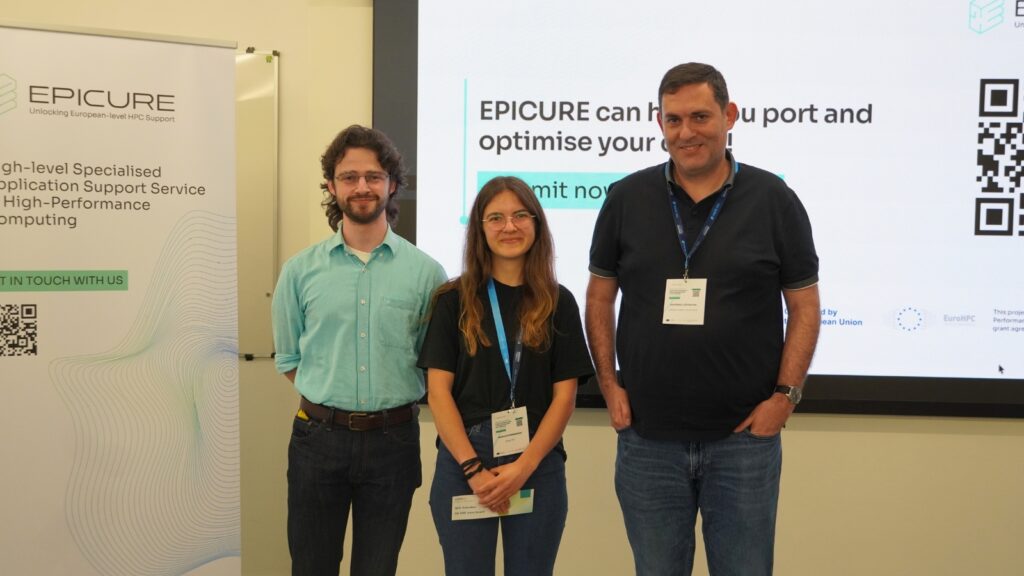
Among the crowd was a dedicated team from Slovenia’s Institute of Information Science (IZUM) and the Jožef Stefan Institute (JSI). They brought stories from the front lines of supercomputing, presenting both a technical talk and a poster session that demonstrated how the EPICURE project was quietly transforming research visions into tangible discoveries. Through their narrative, they showed that high-performance computing (HPC) is not just about raw processing power; it’s about precision, patience, and partnership.
The EPICURE model: expert support where it matters most
By using various parallel processing techniques and multiple compute nodes, supercomputers are now employed to solve complex computational problems that would take conventional computers years or even decades to complete.
However, gaining access to a supercomputer is only the first step.
Writing, optimising, and scaling code to run efficiently across thousands of processors requires highly specialised expertise. This is where the EPICURE project comes in. Funded by the European High-Performance Computing Joint Undertaking (EuroHPC JU), EPICURE brings together 16 partners from 14 European countries, including IZUM and JSI from Slovenia.
Rather than handling basic system access, such as login credentials or simple job submissions, EPICURE focuses on advanced, high-value technical support. This includes custom software installation, performance profiling, code refactoring, and resource optimisation. The project’s specialised support model operates at Levels 2 and 3, ensuring that user applications achieve optimal readiness, stability, and efficiency on target supercomputing architectures such as Slovenia’s HPC Vega.
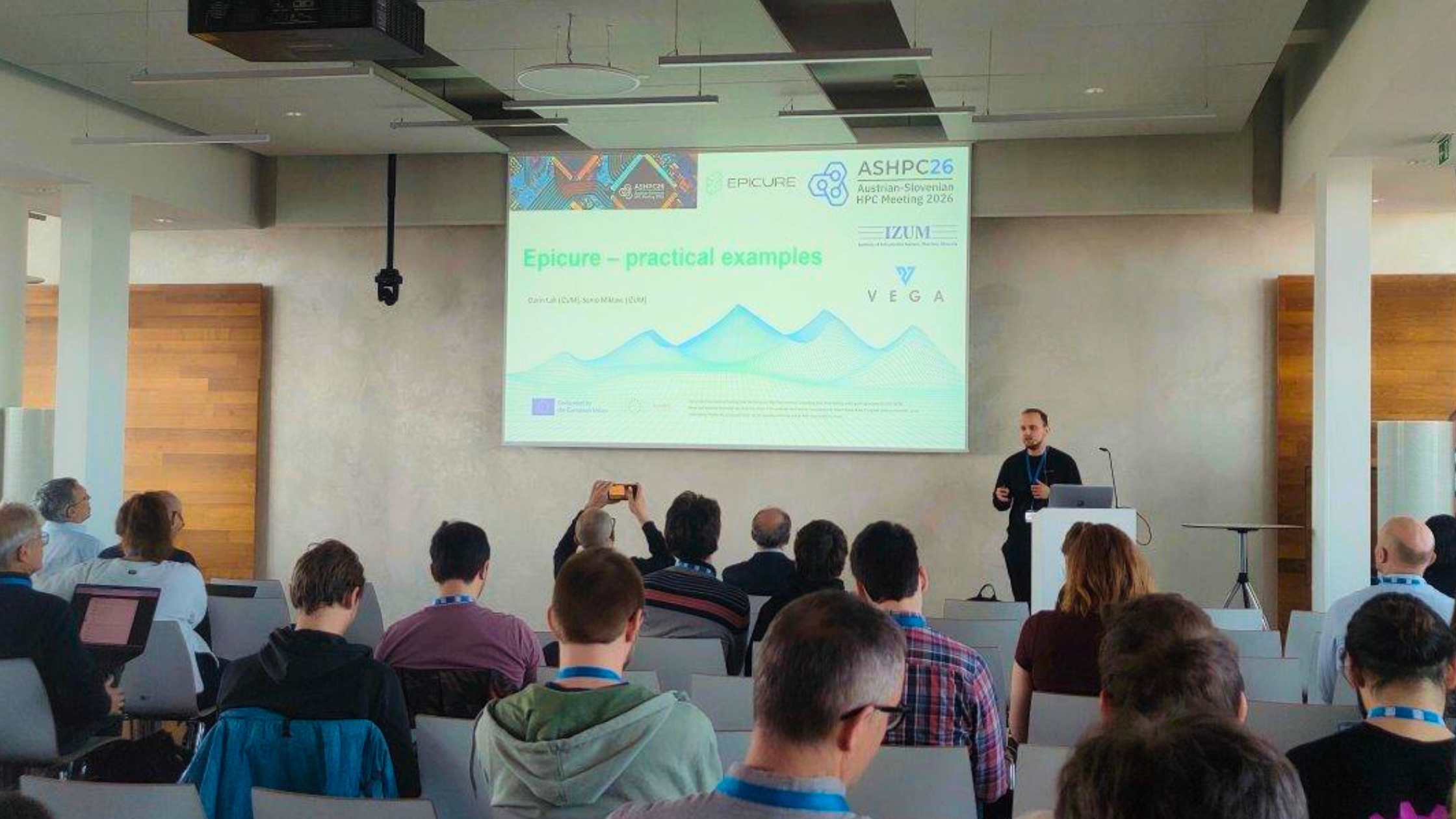
Talk about EPICURE
From theory to practice: real-world challenges & solutions
To best illustrate EPICURE’s support services, the Slovenian EPICURE team conducted a demonstration at ASHPC26. The Slovenian EPICURE team shared concrete case studies presenting how expert intervention transforms computational roadblocks into research milestones.
Project #159: Proprietary Scientific Code
A research group provided a compiled Fortran binary using Message Passing Interface (MPI), a standard protocol for programs communicating across multiple nodes without access to the source code. The researchers faced unstable compute nodes and library conflicts (Libpetsc, MPICH, Libhwloc). By recompiling supporting libraries, such as PETSc with OpenMPI and allocating verified stable CPU nodes, they eliminated crashes and improved stability for multi-node jobs. The takeaway: without access to the source code, high-level code optimisations are not possible.
Project #160: Digital Pathology AI
Researchers aimed to train a single-cell foundation model for medical image analysis. The EPICURE team implemented distributed training using PyTorch Distributed Data Parallel (DDP), a framework that splits model training across multiple GPUs to significantly reduce training time. By systematically monitoring CPU and GPU utilisation and optimising node scaling, the team enabled more experiments within the allocated compute window, accelerating progress towards AI-assisted disease diagnosis.
Project #170: Electromagnetic Simulations
Commercial CST software was successfully migrated from local Windows workstations to HPC Vega. The team configured a FlexLM licence server, optimised Slurm job scheduling scripts, and implemented secure network bypasses to enable seamless offloading of heavy simulations to the supercomputer.
Project #203: Fusion Plasma Simulation
Using the VPIC simulation software (C++ and MPI) across more than 100 nodes, researchers encountered frequent job crashes due to hardware inconsistencies. EPICURE engineers provided a curated list of stable CPU nodes, successfully compiled the code with minor source adjustments, and benchmarked 49- and 125-node configurations, ensuring reliable execution for complex plasma physics research.
Each case highlights a common theme: expert support bridges the gap between theoretical algorithms and practical, scalable execution on modern heterogeneous hardware.
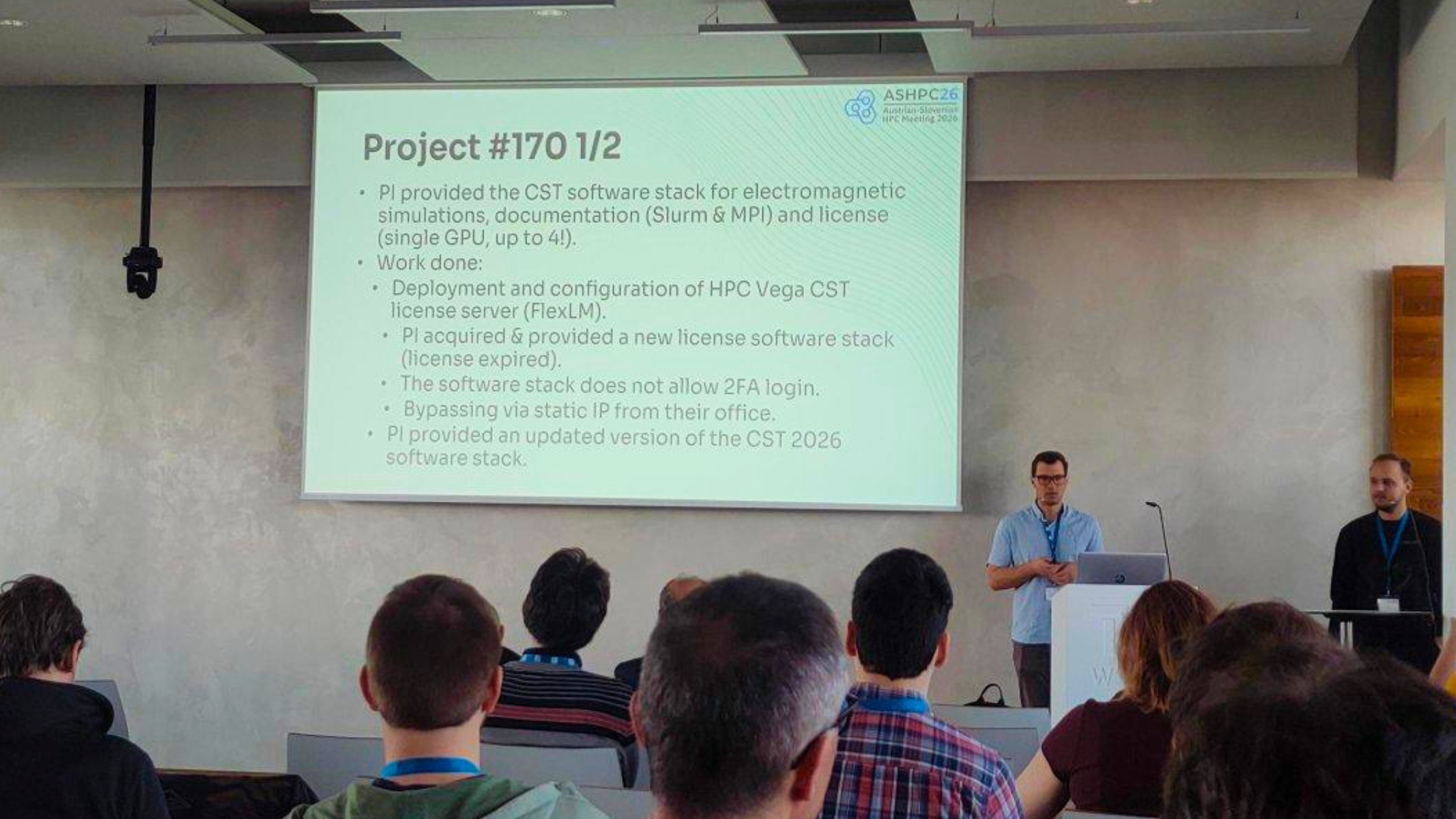
Talk about EPICURE
Why this matters beyond the lab
It is easy to view supercomputing as an abstract endeavour confined to server rooms and academic papers. However, the workflows optimised by EPICURE have direct, tangible implications for everyday life.
When researchers can run larger, more accurate simulations in less time, the ripple effects are profound. Digital pathology models can lead to faster, more precise cancer screenings and personalised treatment plans. Fusion plasma research brings us a step closer to limitless, clean energy, potentially solving long-term climate and energy security challenges. Multiphase turbulence and fluid dynamics simulations help engineers design more efficient wind turbines, predict extreme weather events, and develop sustainable water treatment methods. Even the optimisation of AI workflows reduces energy consumption per calculation, making cutting-edge technology more environmentally sustainable.
By removing technical bottlenecks, EPICURE ensures that HPC infrastructure delivers maximum societal value, translating abstract computational hours into real-world solutions.
Collaboration at the core
EPICURE actively collaborates with National Competence Centres, Centres of Excellence, and academic institutions across Europe. Through hackathons, training sessions, and direct technical assistance, EPICURE fosters a knowledge-sharing ecosystem.
Whether supporting an SME exploring generative AI, assisting a university team modelling molecular dynamics, or enabling cross-border research initiatives, the project democratises access to advanced HPC capabilities.
As highlighted at ASHPC26, success in modern computational science is rarely a solo achievement; it is a coordinated effort between domain experts, HPC engineers, and pan-European support networks.
Conclusion
The stories shared by IZUM and JSI at the Austrian-Slovenian HPC Meeting 2026 reveal a simple and powerful truth: supercomputers do not revolutionise science on their own. They require skilled teams who understand both the hardware architecture and the research objectives.
Through the EPICURE project, Europe is building the human and technical infrastructure needed to unlock the full potential of its most powerful machines. As computational challenges become more complex, such as in personalised medicine or climate resilience, the role of expert HPC support will become increasingly critical.
The future of scientific discovery is about ensuring supercomputers work seamlessly, efficiently, and inclusively for the people who depend on them.
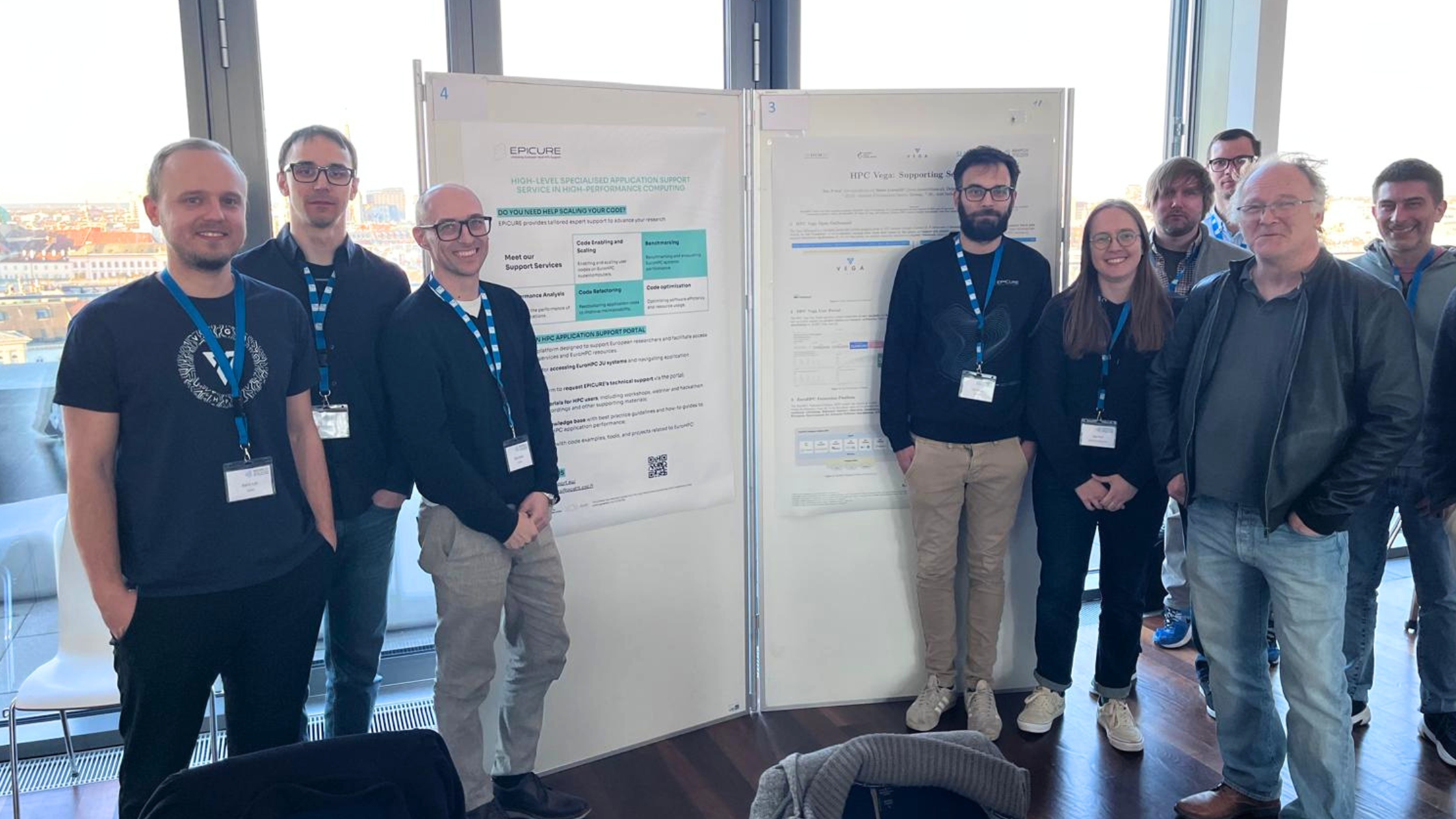
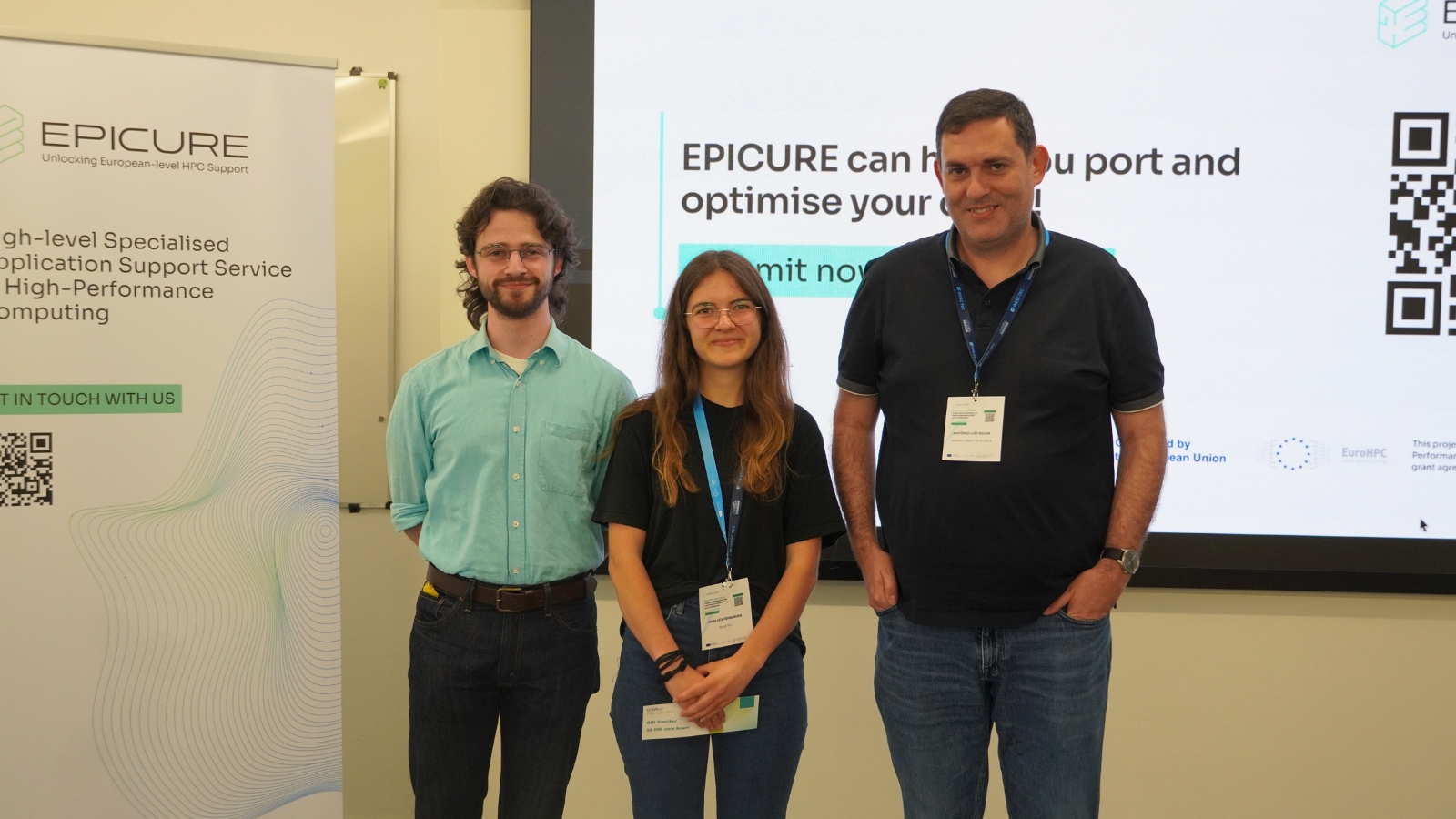
EPICURE’s poster and team