


21/10/2026
Blog
05/08/2026
Three teams, one hackathon: The winning projects of EPICURE’s Code Optimisation Challenge
By the EPICURE Team
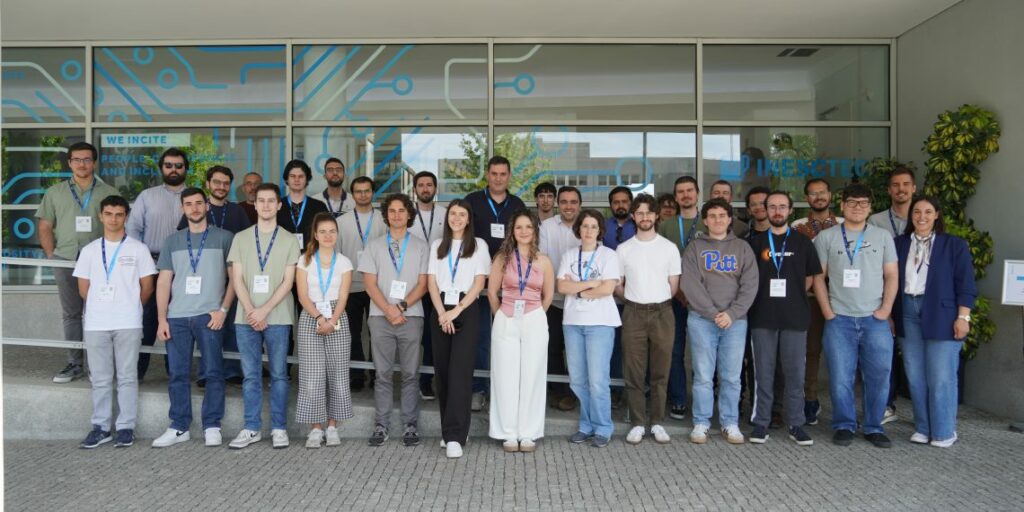
At the Hackathon: Code Optimisation for Heterogeneous HPC Environments, EPICURE brought together researchers to tackle a shared challenge: making their scientific codes run faster and scale better across modern, heterogeneous HPC systems. At the end of the event, three winning teams were selected and received node-hours on the Deucalion supercomputer to continue their work.
Although the three winning projects tackled very different scientific challenges – from computer vision and medical AI to plasma physics – they all demonstrated how targeted optimisation and expert support can unlock substantial performance gains.
Here’s what they achieved.
Computer vision at scale: Nina Lichtenberger
Nina Lichtenberger entered the hackathon with a computer vision pipeline that had never been run in an HPC environment. She focused on two directions: restructuring the pipeline to process multiple images concurrently, leveraging the multi-core CPU resources made available through EPICURE; and systematically refactoring the code itself, which included identifying inefficient function calls, redundant computations, and suboptimal data-handling patterns, then replacing them with leaner alternatives.
The optimisation delivered remarkable improvements. The optimised pipeline now runs approximately 120 times faster than the original implementation. In 16 hours on a single ARM node, Nina could compute feature maps for 480 images, compared to just 4 images at the same time before the hackathon.
With no prior HPC experience, Nina relied heavily on mentor guidance, tutorials, and talks throughout the event. Beyond the technical gains, she highlighted the value of a structured environment that lets her step back from day-to-day research and focus entirely on performance, something she says has motivated her to keep learning about HPC and code optimisation.
Accelerating medical image segmentation: Luís Fernandes
Luís Fernandes set out to accelerate the training of deep learning models for medical image segmentation on GPU-based HPC systems. The main challenge was identifying performance bottlenecks within the training pipeline and restructuring the code to better exploit the capabilities of modern HPC architectures. Working with his mentor, Ziyad AlBanoby (Barcelona Supercomputing Centre), he followed a systematic optimisation methodology: profiling the code with the PyTorch profiler, analysing memory usage and computational overhead, and testing several strategies to improve parallel training and GPU utilisation.
These combined efforts delivered a 20% improvement in runtime speed. This meaningful gain shows the impact of tailoring AI training pipelines to heterogeneous HPC infrastructure.
At the same time, access to HPC resources, expert mentorship, and a collaborative environment made for what Luís describes as an exceptional learning experience, as much a networking opportunity as a technical one. Looking ahead, he plans to deepen his expertise in profiling and optimisation for deep learning, with a particular focus on medical image segmentation.
Speeding up space plasma simulations: the Menura team
Francesco Pucci and the Menura team came to the hackathon already deep into optimising Menura, a hybrid-PIC code used to study complex space plasma dynamics. The team identified two goals: first, to perform a detailed code profiling to confirm the most computationally expensive parts of the simulation; and second, to optimise two components expected to dominate execution time, the moment mapping and the particle pusher.
To approach the optimisation work, the team was divided into two groups. One group focused on code profiling to better understand the behaviour of the code on the target architecture, which confirmed that the heaviest kernels in Menura are indeed the moment mapping and the particle pusher. The second group worked on kernel optimisation, implementing and testing two new versions of the moment mapping and one new version of the particle pusher. These efforts led to a significant improvement in performance, with a speed-up of the total simulation time ranging between 2× and 6×, depending on the configuration.
The Menura team had already been collaborating with EPICURE experts for several months before the hackathon, which gave them a chance to accelerate that ongoing work. During the event, EPICURE’s support was especially valuable in the use of NVIDIA profiling tools such as Nsight and NCU, helping the team interpret results and make informed decisions about new kernel development. As next steps, the team plans to test the new kernels under more challenging conditions, particularly scenarios with MPI load imbalance, and to keep optimising lighter kernels that may become new bottlenecks as the heaviest ones speed up.
Why do hackathons like the EPICURE Hackathon on code optimisation matter?
Across all three projects, a common thread emerges: real performance gains achieved in a matter of days, with the right mix of HPC resources, mentorship, and dedicated time to focus purely on optimisation. For researchers who often can’t justify stepping away from their core work to dig into performance, the hackathon format offers exactly that space.
By combining access to cutting-edge HPC infrastructure with expert mentorship and dedicated optimisation time, EPICURE’s hackathons are helping researchers transform promising scientific codes into faster, more scalable applications ready for the next generation of supercomputing.