


21/10/2026
Blog
09/07/2026
Rethinking HPC User Support for the AI and Exascale Era: Reflections from ISC26
By BoF organising team
High-performance computing (HPC) is changing quickly. With the rise of exascale systems and artificial intelligence (AI), as well as the increasing diversity of user communities, the way people interact with the HPC infrastructure is no longer the same as it was a few years ago. These changes also demand an adaptation of the user support.
This topic was at the centre of our Birds of a Feather (BoF) session “Rethinking HPC User Support for the AI and Exascale Era”, organised at ISC26, one of the world’s leading conferences in HPC, supercomputing, AI, and data-intensive computing.
The term “BoF” comes from the English proverb “Birds of a feather flock together”, meaning that people with similar interests or problems naturally come together. In conference terminology, a BoF session is exactly that: people with a shared interest gather in one room to discuss and exchange experiences, perhaps discovering that their problems are not unique, just widely distributed.
Why HPC user support needs rethinking
Traditionally, HPC user support focused on helping users connect to systems, submit jobs, manage software environments, and troubleshoot technical issues in their code. While these tasks remain essential, the role of support teams has expanded significantly.
Today’s HPC users come from a much broader range of disciplines and technical backgrounds. Some are experienced HPC practitioners, comfortable with command-line tools and batch systems. Others are entering HPC from AI and data science environments and expect more interactive, streamlined ways of working.
As a result, support teams now do far more than reactive troubleshooting. They create documentation, deliver training, develop tools to support users and support teams, debug complex system behaviours, and help users navigate unfamiliar environments. In many cases, they also act as a bridge between rapidly evolving infrastructure and equally rapidly evolving user expectations.
This raises an important question: how can HPC user support remain effective, scalable, and sustainable in the AI and exascale era?
Inside the room: what HPC professionals told us
The session attracted a lot of interest. At its peak, attendance reached 73 participants, almost exhausting the room’s capacity. It was encouraging to see such a diverse audience, including HPC support professionals, infrastructure providers, researchers, representatives from academia and industry, and users, all willing to share their experiences and learn from one another.
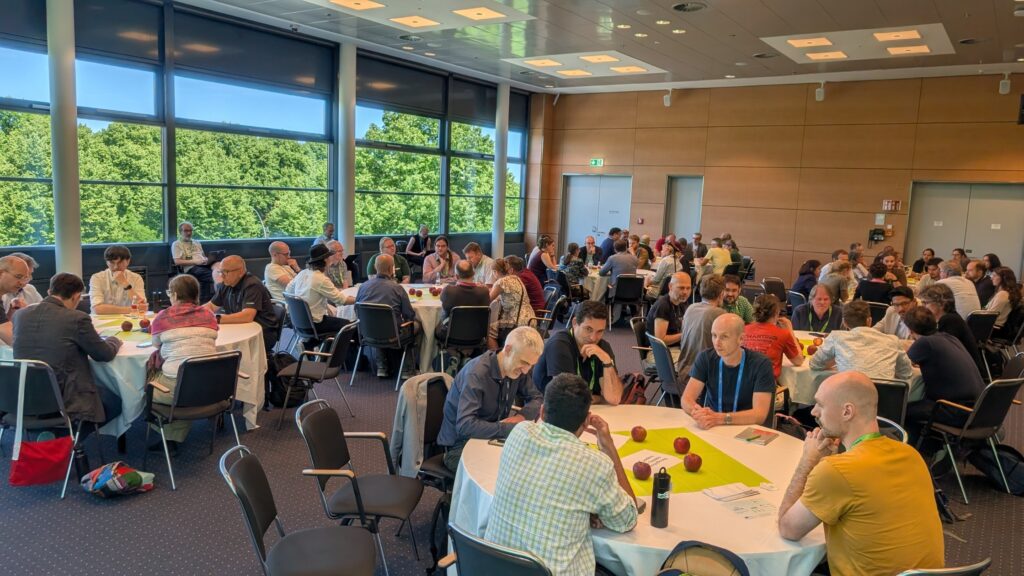
Roundtable discussions during the BoF session.
To better understand the audience, we started with a short live poll: 52 people participated, mostly representing support staff from HPC centres (29) and operations teams (12).
When asked about the biggest challenges they face in user support, three topics clearly stood out:
- – User training and onboarding (26 votes)
- – Staffing and resources (23 votes)
- – Technical complexity (19 votes)
Participants also identified the areas where they believe the greatest improvements are needed:
- – Documentation and self-service resources (21 votes)
- – Better alignment with user needs (15 votes)
- – Training and onboarding (12 votes)
One of the more interesting questions was whether AI will eventually replace user support. The answer from the audience was remarkably consistent: the overwhelming majority agreed that AI will assist support teams, but not replace them.
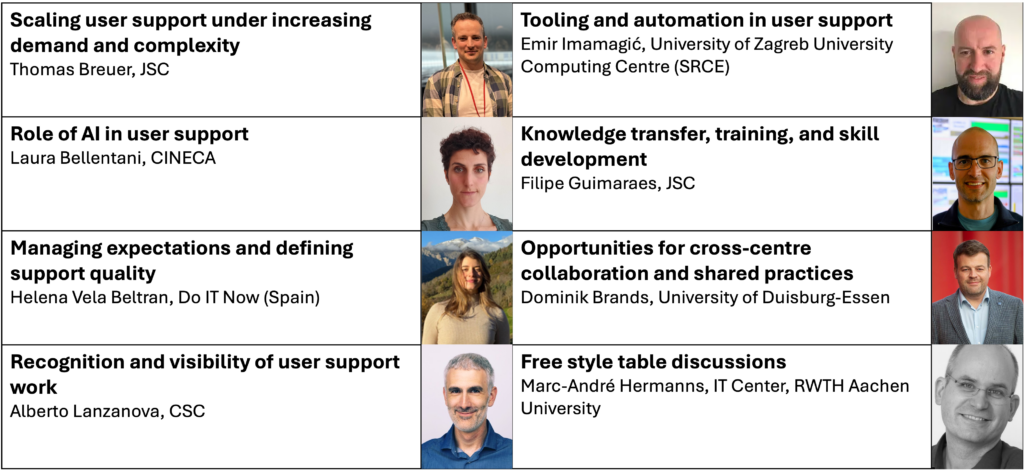
Table topics and designated leaders, who were assigned to guide the discussions.
The following roundtable discussions were energetic and engaging. Despite lasting only 20 minutes, the discussions clearly demonstrated the issue’s relevance and laid the groundwork for further discussion beyond the BoF.
Where the community wants to go next
Each table then reported back a short summary of the discussions and ideas for promising approaches to be taken.
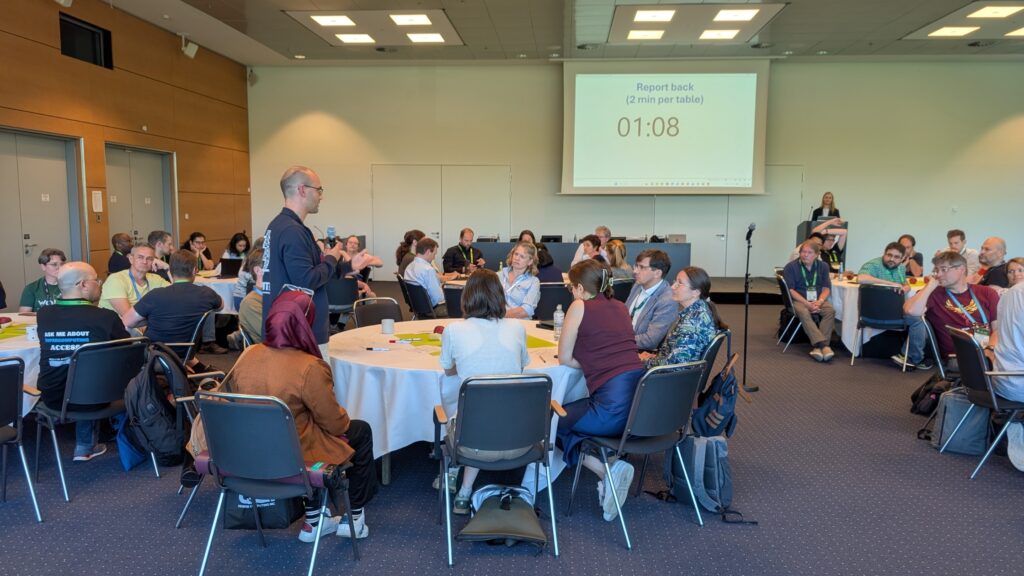
Reporting back the key discussion points.
After the presentations, the participants could walk around and vote, using sticky notes, on the ideas they thought were the best next steps for the community to take.
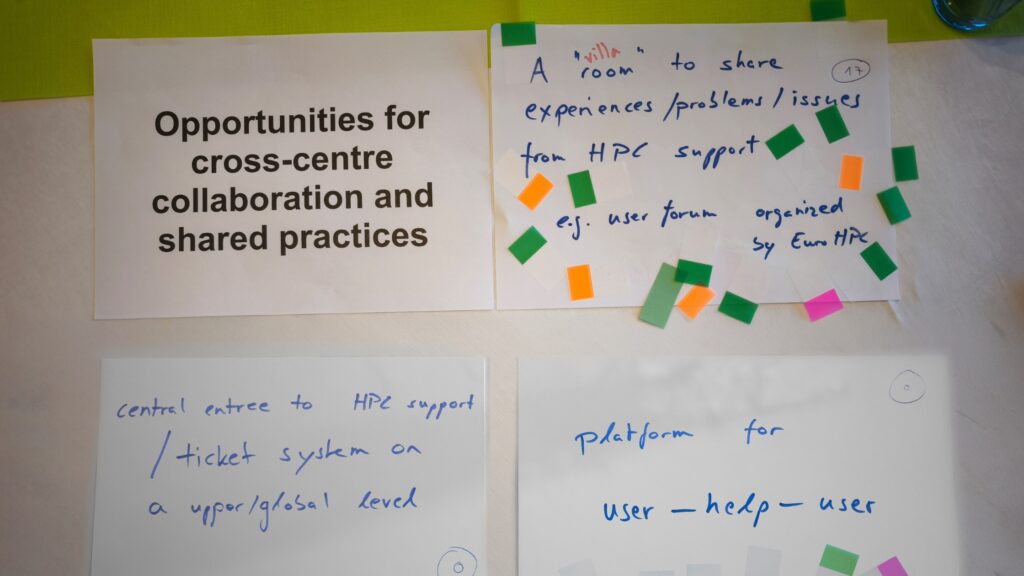
Voting on ideas from the “Cross-centre collaboration and shared practices” discussion table.
Although each group approached the topic from a different perspective, several common themes emerged across the room:
- – Making better use of AI, for example, intelligent documentation search, support chatbots (including voice interfaces), debugging assistants, and AI-powered onboarding;
- – Building a stronger support community by creating spaces where support professionals can exchange experiences, share tools and documentation, and communicate regularly with one another and with users;
- – Providing more direct human support, for example through dedicated mentors or live support sessions to help users overcome challenges more efficiently.
The discussions confirmed that many organisations are facing similar challenges. While there is no single solution, there is strong interest in tackling these issues together rather than independently.
This BoF was only the beginning. We plan to follow up on several of the ideas raised during the session and continue the conversation through future community activities and similar events.
This BoF was jointly organised by representatives of the support initiatives EPICURE, SiVeGCS, and HPC.nrw and by the industry service provider Do IT Now.