


14/10/2026
News
15/06/2026
EPICURE white paper explores GPU utilisation improvements with NVIDIA MPS
The EPICURE team published a new white paper explaining that scientific applications can significantly improve resource efficiency without modifying their source code.
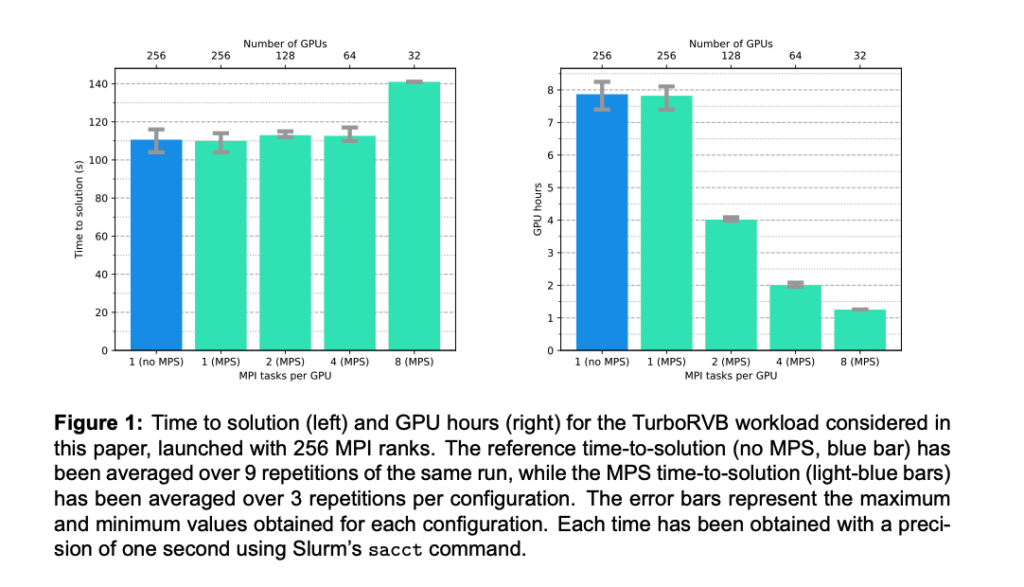
Developed by Laura Bellentani (CINECA), Michele Casula (Sorbonne Université) and Tommaso Gorni (CINECA), the study explores the use of NVIDIA Multi-Process Service (MPS) to optimise Quantum Monte Carlo simulations performed with the TurboRVB code on the Leonardo supercomputer. The results showed that the same simulations could be completed using up to four times fewer GPU-hours while maintaining the same time-to-solution.
According to Tommaso Gorni, this type of optimisation has implications that go well beyond performance alone: “saving 4× GPU-hours means saving 4× energy and 4× money, so it’s fundamental from both sustainability and computational capability points of view. This way, a researcher can perform 4× more simulations with the same budget.”
The white paper also suggests that similar optimisation opportunities may exist in other scientific domains, although outcomes depend on the characteristics and scale of each workload.
Beyond the technical results, the work highlights the value of collaboration between researchers and high-performance computing (HPC) specialists. As Gorni notes, “large efficiency gains can be obtained via a tight exchange between scientists and HPC support teams. The former holds the knowledge of code and of the algorithms, while the latter can suggest unknown optimisation paths based on the scientists’ input.”
The white paper, developed by EPICURE’s application support teams, provides practical guidance for researchers interested in improving GPU utilisation in large-scale scientific simulations.