20/01/2026

Published by Catarina Fernandes 15/11/2026 - 20/11/2026
Categories



Start
10:00 am (CET)
2026/06/02
End
11:00 am (CET)
2026/09/30
Location
Online
About the talk:
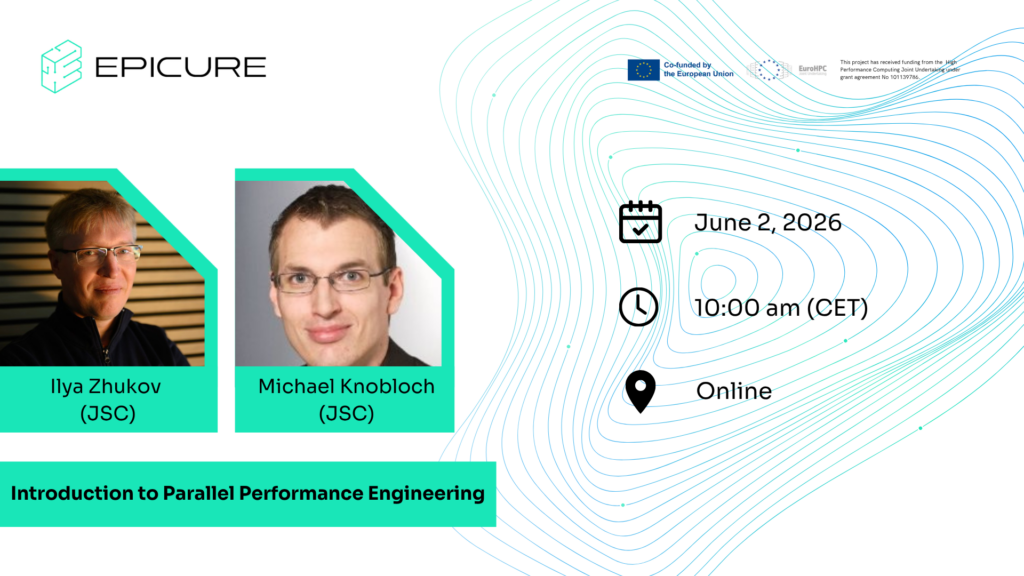
This beginner-friendly webinar provides an introductory overview of performance engineering in high-performance computing. Attendees will gain an understanding of the key performance factors in parallel applications and general workflow that can be employed to analyse and enhance performance. Participants will also be introduced to the concepts of profiling and tracing as essential tools for understanding programme behaviour. This session is intended for those new to the field who wish to develop a foundational understanding of how to approach performance analysis and optimisation in HPC.
About the speakers:
Ilya Zhukov is a senior HPC consultant at the Jülich Supercomputing Centre, with over eight years’ experience supporting users of large-scale HPC systems. He has been closely involved in the POP CoE, SiVeGCS and EPICURE projects at JSC, providing hands-on support to researchers across diverse scientific domains. His primary focus is on helping users exploit HPC systems efficiently and improve the performance and scalability of their applications.
Michael Knobloch obtained his diploma in Mathematics from TU Dresden in 2008. He joined Jülich Supercomputing Center at Forschungszentrum Jülich in 2009 where he works as a HPC performance engineer ever since. His research interests include, but are not limited to, performance and energy consumption analysis of large-scale HPC systems and applications and the development of corresponding tools. He is an active member of the MPI forum and regularly gives courses about parallel programming and performance analysis.
About the moderator:
António Sousa is an Associate Professor at the Department of Informatics of the University of Minho and a Senior Researcher at the High-Assurance Software Laboratory (HASLab) at INESC TEC, where he serves as Co-coordinator. His research interests focus on dependable distributed systems, with particular application to distributed database systems, large-scale distributed systems, cloud computing management, and high-performance computing — notably on topics related to the management and efficiency of HPC systems. He serves as Director of Operations of the EuroHPC Deucalion supercomputer, hosted by the National Center for Advanced Computing, and Portugal’s national HPC flagship infrastructure, playing a central role in its operation and strategic development. He has been involved in several European HPC projects, RISC2, EUROCC1 and 2 and currently in EPICURE and HANAMI.
About the talk:
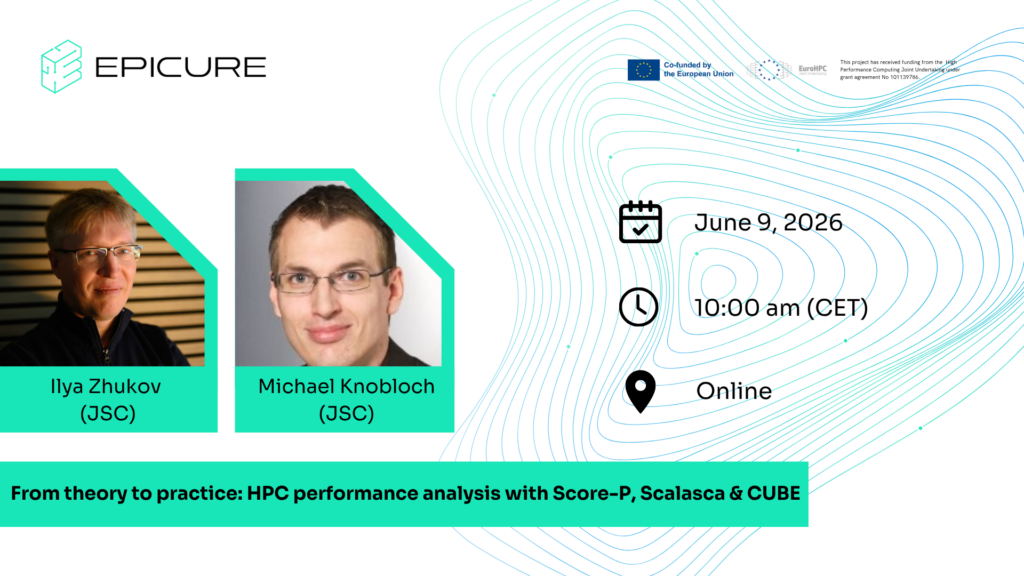
This webinar introduces practical performance analysis using tools such as Score-P, Scalasca, and CUBE. Through a demonstration, participants will learn how to profile and analyse application performance, identify bottlenecks, and interpret results effectively. The session is aimed at beginners who want to move from basic concepts to practical performance analysis in HPC.
About the speakers:
Ilya Zhukov is a senior HPC consultant at the Jülich Supercomputing Centre, with over eight years’ experience supporting users of large-scale HPC systems. He has been closely involved in the POP CoE, SiVeGCS and EPICURE projects at JSC, providing hands-on support to researchers across diverse scientific domains. His primary focus is on helping users exploit HPC systems efficiently and improve the performance and scalability of their applications.
Michael Knobloch obtained his diploma in Mathematics from TU Dresden in 2008. He joined Jülich Supercomputing Center at Forschungszentrum Jülich in 2009 where he works as a HPC performance engineer ever since. His research interests include, but are not limited to, performance and energy consumption analysis of large-scale HPC systems and applications and the development of corresponding tools. He is an active member of the MPI forum and regularly gives courses about parallel programming and performance analysis.
About the moderator:
Cláudia Brito is currently an Assistant Researcher at INESC TEC (and part of the DSR HASLab group) and an Invited Assistant Professor at the University of Minho. Her current research focus is on AI for Systems and Systems for AI. In detail, her research interests have been shifting towards the following topics: AI for systems optimisations and tuning, Storage optimisations for AI workloads, Energy consumption optimisation for data-intensive workloads, Application-specific AI for healthcare.
About the talk:
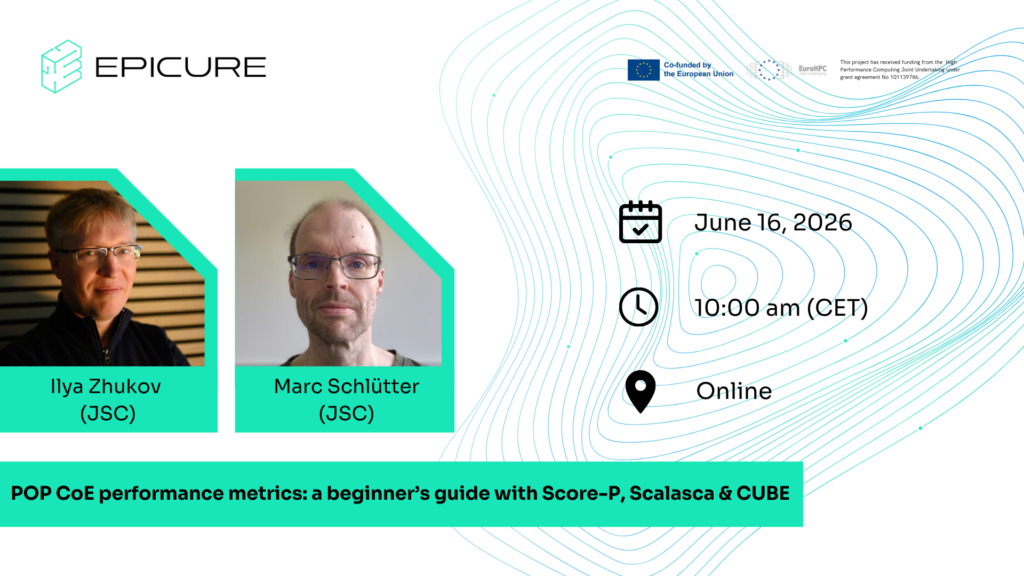
This webinar introduces the POP CoE and its services. It provides an overview of the fundamental POP metrics employed in the assessment of parallel efficiency and scalability. Through demonstrations using tools such as Score-P, Scalasca and CUBE, participants will learn how to compute and interpret these metrics in practice. This session is aimed at those who want to understand standardised approaches to evaluating and improving HPC application performance.
About the speakers:
Ilya Zhukov is a senior HPC consultant at the Jülich Supercomputing Centre, with over eight years’ experience supporting users of large-scale HPC systems. He has been closely involved in the POP CoE, SiVeGCS and EPICURE projects at JSC, providing hands-on support to researchers across diverse scientific domains. His primary focus is on helping users exploit HPC systems efficiently and improve the performance and scalability of their applications.
Marc Schlütter is a research scientist at the Jülich Supercomputing Centre since 2010 with a focus on performance tools development in the context of the instrumentation and measurement framework Score-P. As part of projects like Mont Blanc, DEEPSEA and POP his focus has been support of application developers through a combination of user support, training and performance analysis.
About the moderator:
António Sousa is an Associate Professor at the Department of Informatics of the University of Minho and a Senior Researcher at the High-Assurance Software Laboratory (HASLab) at INESC TEC, where he serves as Co-coordinator. His research interests focus on dependable distributed systems, with particular application to distributed database systems, large-scale distributed systems, cloud computing management, and high-performance computing — notably on topics related to the management and efficiency of HPC systems. He serves as Director of Operations of the EuroHPC Deucalion supercomputer, hosted by the National Center for Advanced Computing, and Portugal’s national HPC flagship infrastructure, playing a central role in its operation and strategic development. He has been involved in several European HPC projects, RISC2, EUROCC1 and 2 and currently in EPICURE and HANAMI.
About the talk:
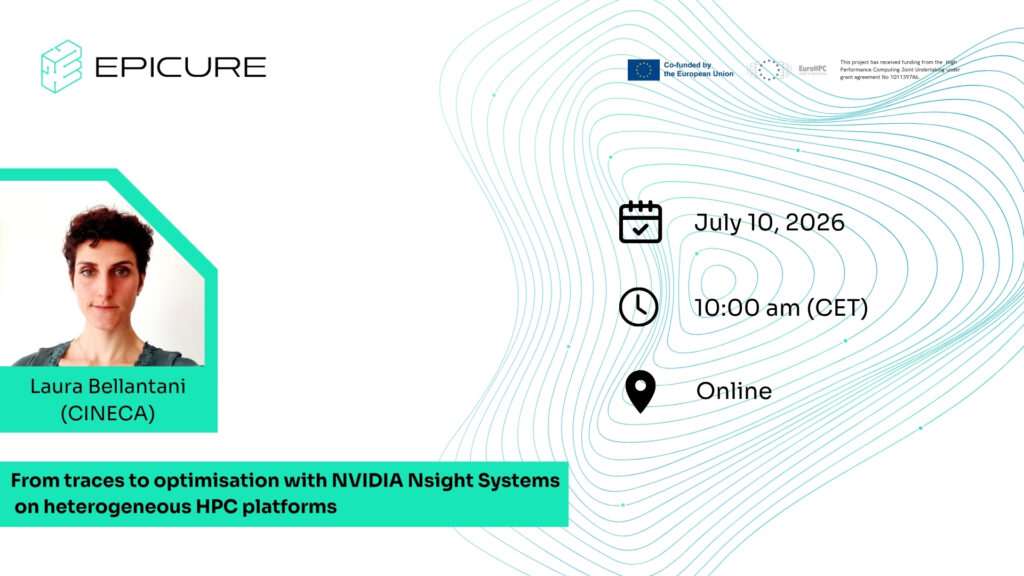
Modern HPC applications distribute their work across CPU and GPU, and understanding where time is actually spent requires observing both architectures simultaneously within a single coherent framework. This webinar presents NVIDIA NSight Systems as the foundation of performance engineering workflow for NVIDIA architectures: participants will learn how to instrument and collect traces with nsys, use NVTX ranges to improve timeline readability, filter the profiling session to the relevant portions of the application, and how to interpret the timeline and post-processing summaries to extract meaningful insight from the data. The session will cover the most relevant performance factors in heterogeneous programming, from data locality and stream concurrency to GPU awareness in distributed MPI runs, with the goal of making informed and targeted optimisation decisions.
About the speaker:
Originally trained as a physicist, Laura Bellentani specialised in High-Performance Computing during her PhD in Physics and Nanosciences at the University of Modena and Reggio Emilia. Since 2021, she has been a member of the High-Level Support Team at CINECA, where her work focuses on porting applications to GPUs. She maintains a focus on balancing performance with code maintainability and portability, viewing profiling as an indispensable tool for achieving effective and sustainable optimisations.
About the moderator:
Isabel Rio-Torto received the Ph.D. in Computer Science from the Faculty of Sciences of the University of Porto (FCUP) in 2026 and the master’s degree in Electrical and Computers Engineering from the Faculty of Engineering of the University of Porto (FEUP) in 2019. Alongside her role as a researcher at INESC TEC, she is an Invited Teaching Assistant at FEUP and FCUP, teaching C programming, Computer Vision, and Artificial Intelligence. Isabel has extensive experience using HPC systems, particularly for GPU-based AI training and inference in PyTorch, including work with Large (Vision) Language Models.
About the talk:
This talk introduces the AMD ROCm profiling toolchain, which integrates three tools: rocprof collects hardware counters and traces, rocprof-sys provides a whole-application view (combining CPU sampling, GPU activity, and MPI/OpenMP awareness) to locate hotspots, and rocprof-compute performs in-depth kernel analysis using speed-of-light metrics and the roofline model.
About the speaker:
Matteo Murdaca is an MSc student in Engineering Physics who joined CSC as a trainee in 2025. His work focuses on supporting users through application installation and containerisation, training, and performance optimisation.
About the moderator:
Isabel Rio-Torto received the Ph.D. in Computer Science from the Faculty of Sciences of the University of Porto (FCUP) in 2026 and the master’s degree in Electrical and Computers Engineering from the Faculty of Engineering of the University of Porto (FEUP) in 2019. Alongside her role as a researcher at INESC TEC, she is an Invited Teaching Assistant at FEUP and FCUP, teaching C programming, Computer Vision, and Artificial Intelligence. Isabel has extensive experience using HPC systems, particularly for GPU-based AI training and inference in PyTorch, including work with Large (Vision) Language Models.