


21/10/2026
Blog
01/07/2026
Building Better HPC Software Stacks: EPICURE at the EasyBuild User Meeting
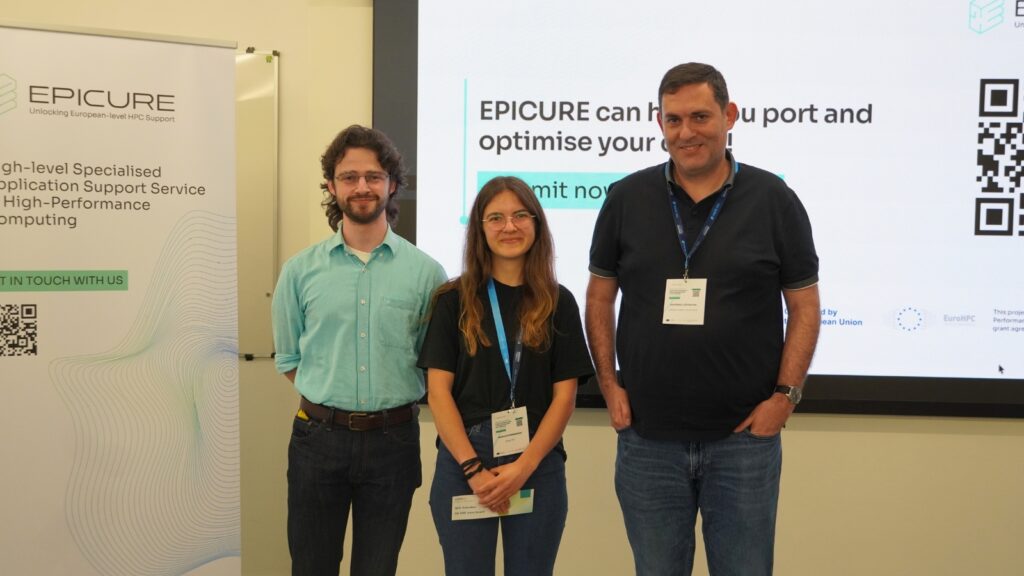
Bernardo Malaca (CNCA/Deucalion), Bibek Chapagain (BSC) and Kenneth Hoste (Ghent University)
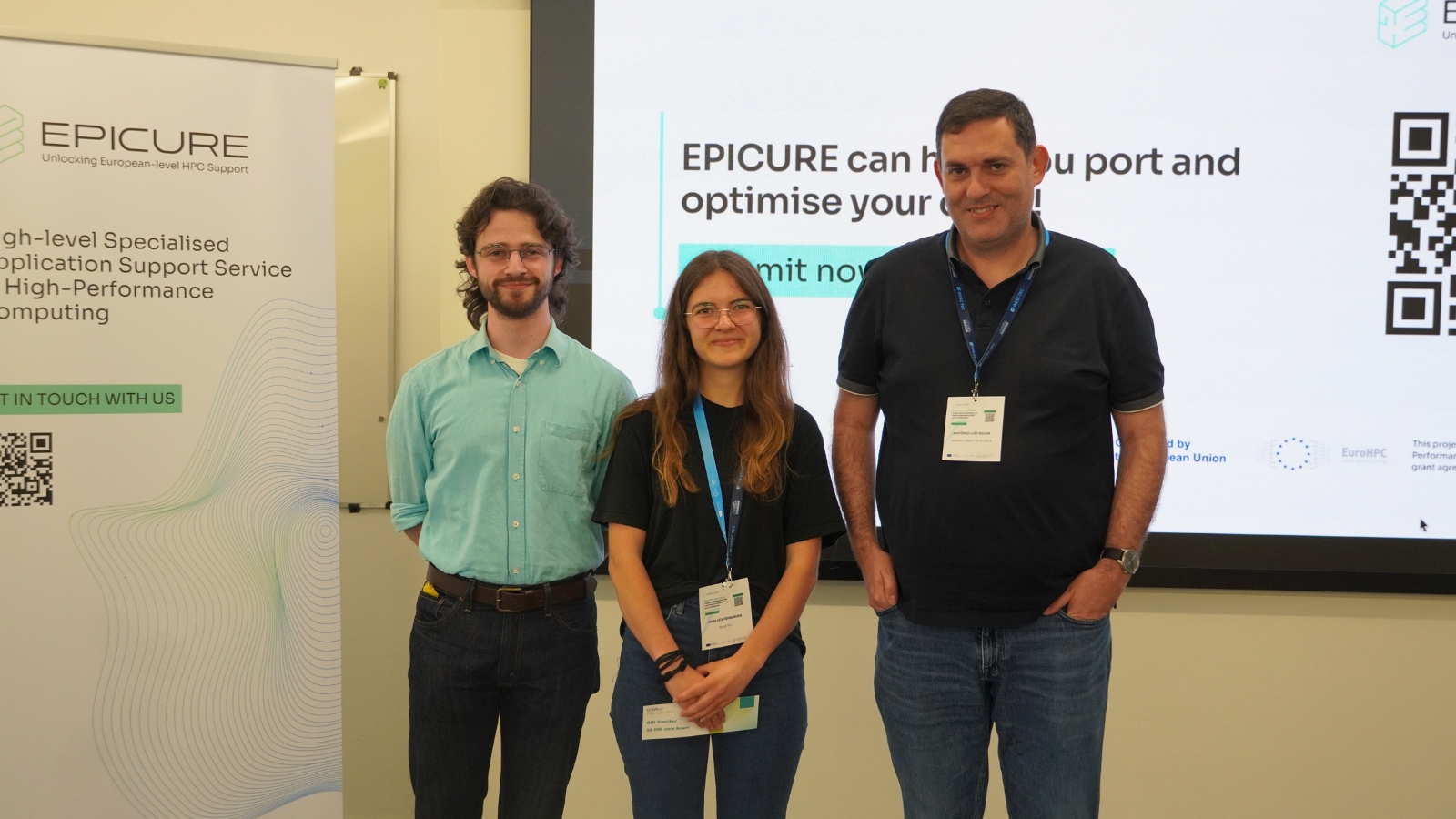
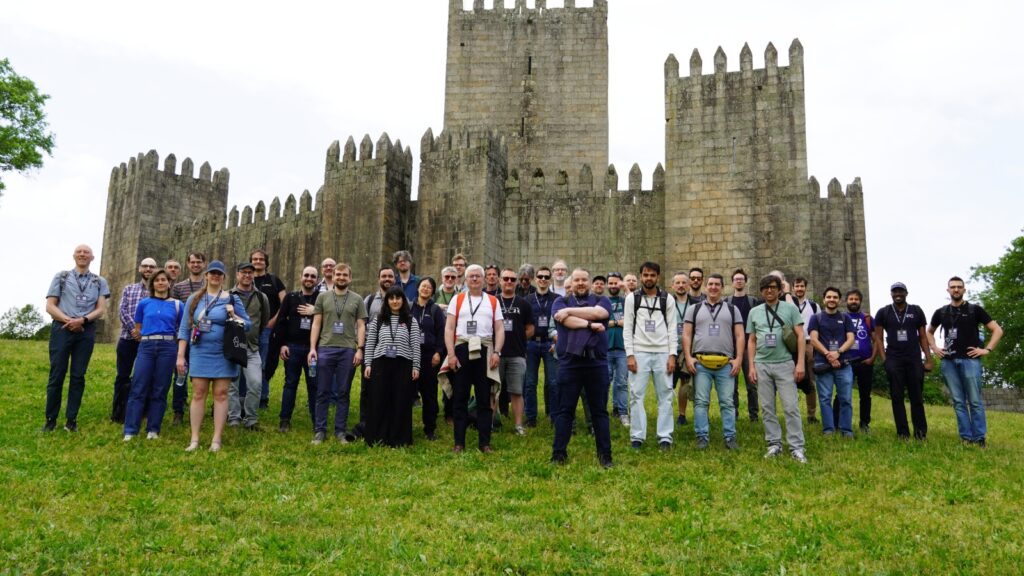
Between April 21st and 23rd, 2026, the EasyBuild User Meeting (EUM) 2026 was held in Guimarães, hosted on the home of the Deucalion supercomputer. The EUM is a yearly gathering that brings together high-performance computing (HPC) centres, developers, and users of EasyBuild, the open-source tool that has become a cornerstone for installing and maintaining scientific software across supercomputing sites in Europe.
The EPICURE project was there, and the event brought together three very different points on why EasyBuild matters: a user support perspective from within EPICURE, a site-specific perspective from Deucalion itself, and the perspective of the person who started it all and the perspective of the lead developer of EasyBuild.
Why EasyBuild matters to a project like EPICURE
Most researchers using HPC systems are focused on their applications and simulations. HPC centres need to install and maintain huge volumes of scientific software, and doing this manually, system by system, doesn’t scale.
Bibek Chapagain, from Barcelona Supercomputing Center (BSC), from the EPICURE project’s user support team, explains why EasyBuild has become essential to that work: recipes built at one HPC centre can be reused at another, turning what used to be a one-off, manual effort into something reproducible and portable. For a project like EPICURE, which spans multiple HPC sites across Europe, this portability is core to how the project operates. Software installed for one centre often needs to run on a completely different system, and EasyBuild makes that transition manageable. It also brings a side benefit that is easy to overlook because the same software versions and similar installation procedures are used across systems, benchmark comparisons between sites become far more consistent and trustworthy.
Another important point is time-saving. Once a working recipe exists for one architecture, adapting it for a similar one elsewhere usually takes minimal effort. Easybuild makes deployment faster, more reproducible, and considerably easier to maintain across the whole EPICURE network.
A real-world test case: Deucalion’s triple architecture
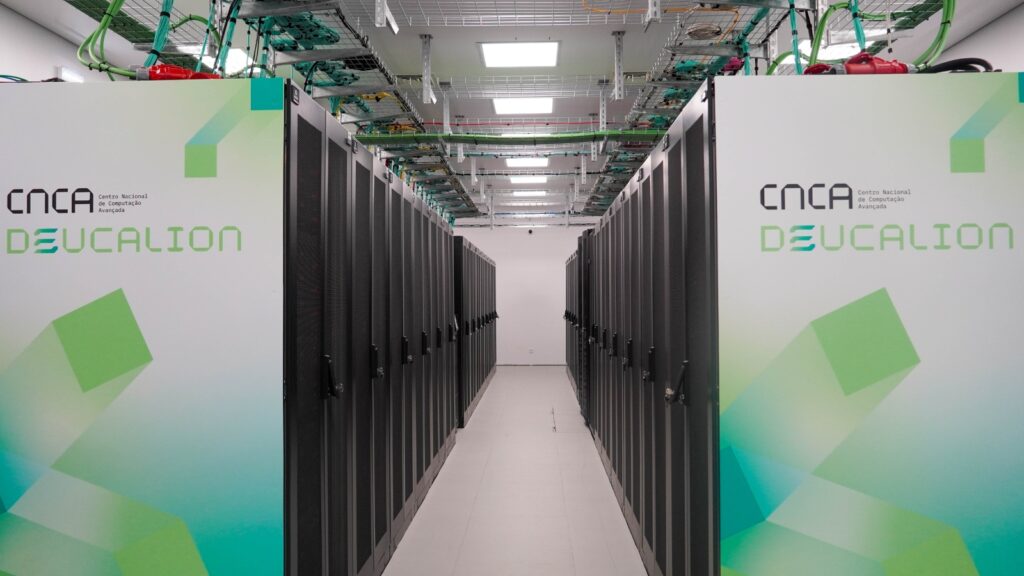
Deucalion, the Portuguese supercomputer hosted in Guimarães, shows why a tool like EasyBuild is indispensable.
Bernardo Malaca, from the Deucalion support team, describes the supercomputer as a particular machine with three different architectures: x86, ARM, and GPU-accelerated. Installing a single piece of software effectively means doing the work at least twice, once per CPU architecture. Without a tool like EasyBuild to standardise installations, auto-generate modules, and resolve dependencies, this process would place a heavy burden on the support team.
But according to Bernardo, the real value of EasyBuild is the community: people openly sharing their own recipes with the rest of the world.
On Deucalion’s ARM partition, EasyBuild makes it far easier to compare software built with different toolchains (GCC, Clang, Fujitsu, and others), helping the team identify and recommend the best version of each package. And when a recipe (a.k.a. an easyconfig file) doesn’t exist yet, adapting an existing one is usually straightforward, which is a real advantage for fast-moving software ecosystems like Python.
The result speaks for itself: Deucalion is able to sustain similar software stacks (with more than 4000 software installations, counting different versions), which would have been very difficult to set up without these tools.
From a Ghent University side project to a European software catalogue
To understand where EasyBuild came from, there’s no better guide than Kenneth Hoste, lead developer of EasyBuild at Ghent University, core contributor to EESSI, and a partner in the MultiXscale EuroHPC Centre of Excellence and the consortium developing the EuroHPC Federation Platform.
EasyBuild started in 2009 at Ghent University out of necessity: there wasn’t a widely used tool for installing scientific software from source on HPC systems, even though every centre faced that exact burden. The HPC team at Ghent University made it publicly available as open source software in 2012, initially just hoping for feedback from more experienced HPC sites; instead, a community quickly emerged, with sites across the world adopting the tool and contributing back.
By 2016, the project was receiving more than 2,000 pull requests a year, prompting the team to expand maintainership beyond Ghent University. By 2025, that number had grown to over 3,400 pull requests annually. Since 2016, the community has also gathered every year at the EasyBuild User Meeting (EUM), the same event that brought Kenneth to Guimarães.
Along with the EasyBuild growth, the HPC landscape and infrastructure have changed. As more scientific fields adopt computational methods, the sheer volume of software that needs installing keeps growing. At the same time, supercomputer architectures have shifted from largely homogeneous Intel-CPU systems to a much more varied landscape.
This shift is what led to the European Environment for Scientific Software Installations (EESSI), a community project that emerged from the EasyBuild community in 2020. EESSI goes a step further than EasyBuild: instead of each site building its own software installations, EESSI provides a shared stack prepared for most CPU and GPU hardware found in supercomputing facilities. Kenneth describes it simply as a streaming service for scientific software, in which you can browse the catalogue, pick what you need, and start using it, whether you’re on a supercomputer, your laptop, a cloud VM, a CI runner, or even a Raspberry Pi.
EESSI is now being integrated into the EuroHPC Federation Platform (EFP) as the base for its Federated Software Catalogue, a consortium effort led by CSC, operators of the LUMI supercomputer. This means that EESSI is set to become widely available across the entire EuroHPC ecosystem.