


21/10/2026
Blog
Scaling financial AI for non-English markets with EuroHPC
By Derya Uysal (Yapı Kredi Teknoloji)
There has never been more information and investment advice available than today. The rapid digitalisation of financial services has increased the demand for intelligent systems that can interpret financial language and provide personalised advice.
However, most financial AI systems are designed for English-speaking users. Even when translated, they often lack sufficient capability to handle domain-specific terminology in other languages, such as Turkish. This creates a significant gap for investors who rely on accurate, context-aware information to make decisions.
To address this challenge, Yapı Kredi Teknoloji is developing the Financial Virtual Assistant for Portfolio Management (FVAP), a Turkish large language model (LLM) specialised in investment funds, portfolio management, and financial advisory services. The system is designed to understand user queries, extract intents and entities, determine investor risk profiles, and generate context-aware portfolio allocation recommendations.
With support from EPICURE, Yapı Kredi Teknoloji developed a financial language model capable of understanding complex Turkish financial terminology and delivering more accurate, context-aware insights.
Scientific and technical challenges
Building a scalable financial assistant requires domain-specific natural language processing (NLP) with large-scale model training and distributed GPU computing. As the system evolves, it must handle increasingly complex financial language while maintaining accuracy and consistency across different use cases.
However, scaling these models introduces significant technical challenges. Training and finetuning LLMs on domain-specific datasets demands substantial memory capacity, high-throughput communication, and efficient parallel execution, particularly when using multi-GPU and multi-node configurations.
“During the process, we encountered several technical challenges, including CUDA–PyTorch compatibility issues, inefficient GPU utilisation, communication overheads, and performance bottlenecks, particularly those related to the BitsandBytes library,” explained Derya Uysal. These constraints negatively affected performance and increased the complexity of maintaining stable workflows.
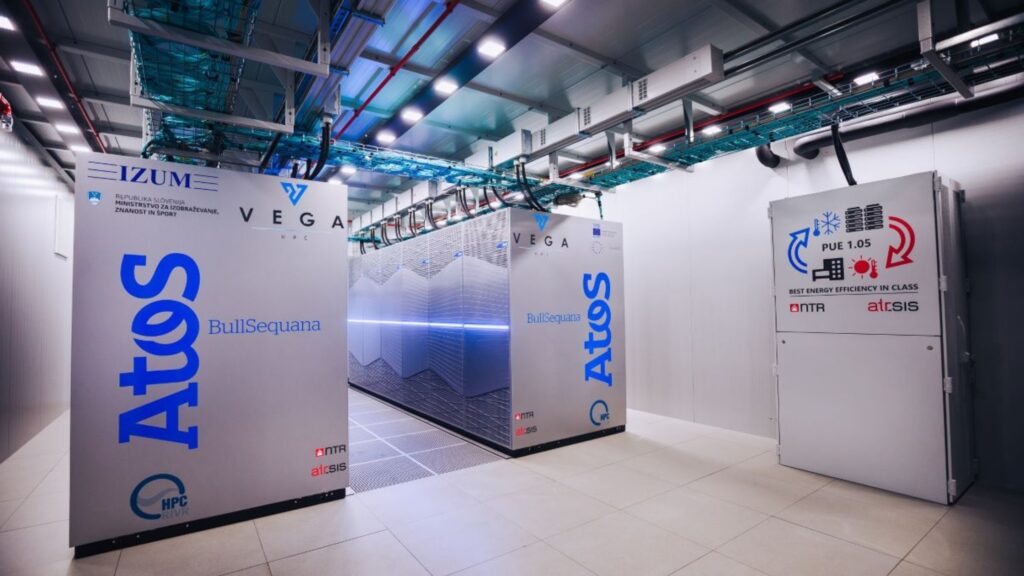
For this reason, the project leveraged the advanced computing resources and expert support services available within the EuroHPC ecosystem.
How did EPICURE support the project?
To overcome these challenges, Yapı Kredi Teknoloji used EuroHPC resources to perform large-scale training and domain adaptation experiments. High-performance GPU systems enabled distributed workloads that would not be feasible in conventional IT environments, allowing the team to train transformer-based language models for tasks such as investor profiling, intent recognition, and portfolio advisory generation.
At this stage, EPICURE support played a decisive role in stabilising and optimising the training pipeline. The application support team provided guidance in configuring the software environment, identifying compatible combinations of CUDA toolkits, PyTorch versions, and supporting libraries. They also assisted in benchmarking the application, analysing scaling behaviour, and optimising communication patterns across GPUs.
This collaboration helped resolve key bottlenecks in the training process, improving GPU utilisation, stabilising distributed runs, and significantly reducing inefficiencies. Beyond performance gains, the support also enabled faster troubleshooting and more efficient use of allocated computing resources.
The technical advancements achieved during the optimisation process also ensured that the developed solution evolved into a flexible architecture that can be adapted to other financial institutions in the future.
Results and impact for public safety
With these optimisations in place, the project successfully trained and evaluated financial-domain language models capable of understanding Turkish financial terminology and investor queries. The improved training workflows allowed the team to experiment with larger datasets and achieve higher accuracy in key tasks such as intent recognition, risk profiling, and financial document understanding.
From an operational perspective, the EPICURE support translated into reduced debugging effort, faster convergence during training, more stable distributed runs, and better utilisation of allocated compute hours. “The team was able to focus more on model quality and experimentation rather than infrastructure troubleshooting,” said Derya Uysal.
These technical advancements also enabled the development of a flexible and scalable architecture that can be adapted to other financial institutions. By reducing the complexity of large-scale model training and improving reliability, the project created a strong foundation for deploying AI-driven advisory systems in real-world financial environments.
Beyond the technical results, the project has broader implications. By enabling intelligent financial assistants for non-English users, FVAP contributes to improving financial literacy and access to high-quality investment guidance.
Beyond the technical results, the project has broader implications. By enabling intelligent financial assistants for non-English users, FVAP contributes to improving financial literacy and broadening access to high-quality investment guidance.

Next steps
Following these results, future work will focus on expanding the training dataset, improving the model’s reasoning capabilities for financial decision-making, and integrating the system into real-time financial advisory platforms. Another key objective is the development of a fully operational conversational assistant capable of interacting with investors and providing dynamic portfolio recommendations.
To learn more about the Financial Virtual Assistant for Portfolio Management project, visit the project page on the European HPC application support portal and explore the product page on the Yapı Kredi Teknoloji website.