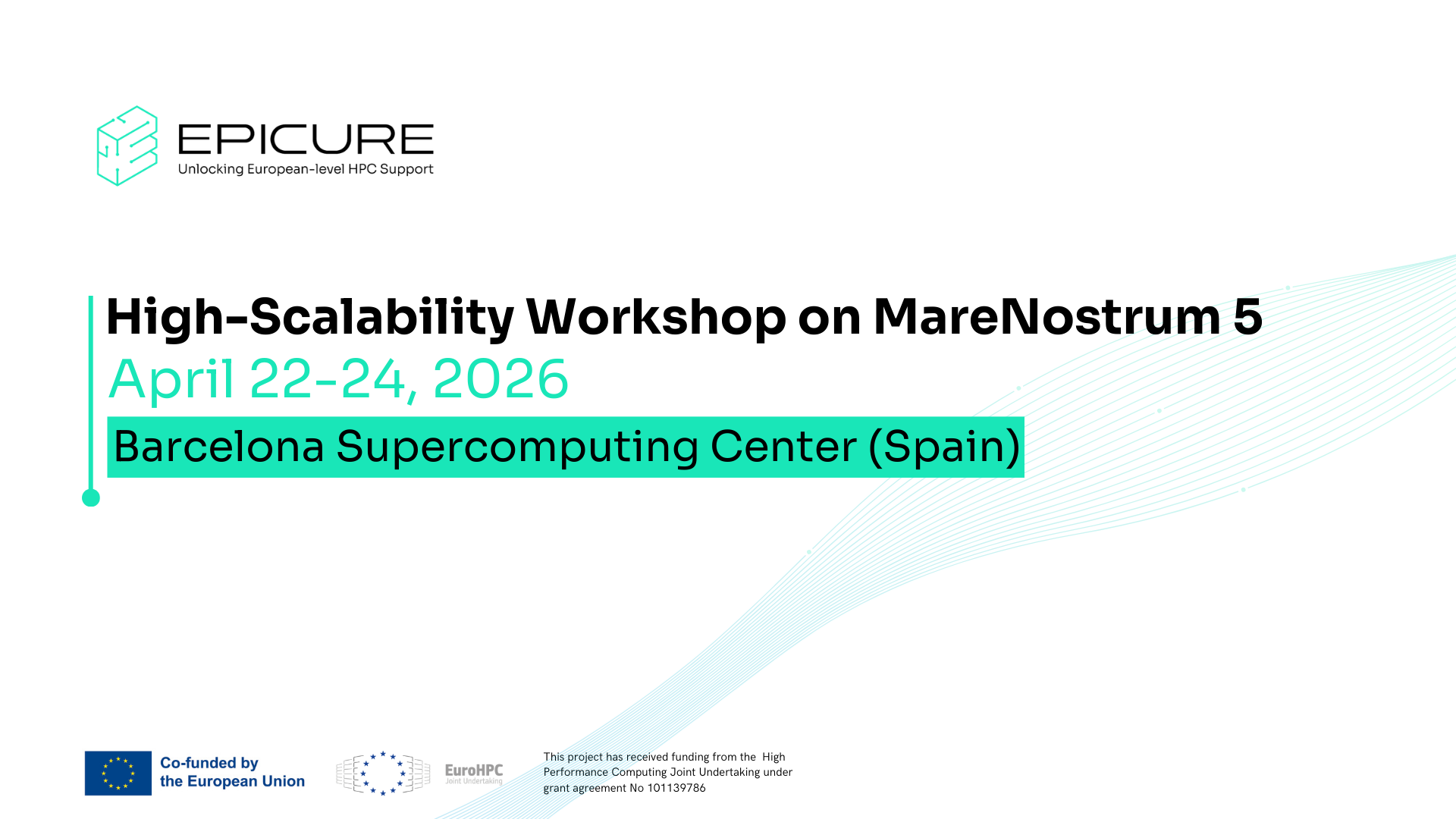



High-Scalability Workshop on MareNostrum 5
Start
2026/04/22
End
2026/04/24
Location
Barcelona Supercomputing Center, Spain
This workshop is dedicated to the development, optimisation, and execution of highly scalable codes on one of Europe’s most powerful supercomputers, MareNostrum 5. It is designed for research teams and advanced users who aim to push their applications to extreme scale and fully exploit modern high-performance computing (HPC) architectures.
The event will take place at the Barcelona Supercomputing Center (BSC), Plaça Eusebi Güell 1–3, 08034 Barcelona, Spain.
Registration
Registration is closed.
EPICURE will provide coffee breaks and lunches during the event. Kindly note that accommodation and travel costs are not covered.
Workshop focus
The program will combine technical presentations with hands-on sessions, covering:
- – Strategies for large-scale parallelisation
- – Advanced debugging techniques at scale
- – Performance tuning and optimisation
- – In-depth performance analysis across a large number of nodes
- – Best practices for efficient use of cutting-edge HPC systems
Participants will have the opportunity to work with a substantial fraction of MareNostrum 5 during the workshop. If their applications demonstrate strong scalability and robustness, the final day will offer the possibility to execute runs on the full machine, providing a unique opportunity to validate extreme-scale performance.
Agenda
10:30 – Registration
11:00 – Welcome and opening remarks
11:15 – Team introductions (5 minutes per team)
12:15 – Starting work on team workflow and compilation process
13:00 – Lunch break
14:00 – Using DDT at scale (thousands of nodes)
14:30 – Using TALP for large-scale runs
15:15 – Scalability work with mentors (per team)
16:00 – Coffee break
16:20 – Scalability work with mentors (per team)
17:15 – Daily wrap-up and preparation for day 2
09:00 – Welcome back & review of day 1 outcomes
09:20 – Team work: high-scalability runs
10:45 – Coffee break
11:00 – Introduction to tracing and using paraver
11:45 – How to profile CUDA codes
12:15 – Team work: high-scalability runs
13:30 – Lunch break
14:30 – Best practices for large-scale jobs on MareNostrum 5
15:00 – Team work: high-scalability runs
17:15 – End of day 2
09:00 – Welcome back & review of day 2 outcomes
09:15 – Sceduling for very large jobs using the full machine
09:30 – Team work: high-scalability runs
11:00 – Coffee break
11:30 – Team work: high-scalability runs
13:00 – Lunch break
14:00 – Final job submissions
16:00 – End of the workshop
Access to accelerated resources
The workshop will also provide access to the accelerated partition, enabling participants to run and benchmark GPU-enabled applications. This makes the event particularly suitable for:
- – AI and machine learning workloads;
- – Large-scale simulations with GPU acceleration;
- – Training and benchmarking large language models (LLMs) and other data-intensive applications.
Participant profile
Applicants are expected to:
- – Be owners or expert users of a highly scalable code
- – Possess sufficient technical expertise to independently run, analyse, and interpret large-scale executions
- – Be prepared to actively optimise and adapt their applications during the workshop
The event is intended for teams capable of directly benefiting from extreme-scale runs and translating the results into scientific or technological impact.
Selection criteria
Due to the limited number of teams, if the number of applications exceeds the available slots, a selection process will be carried out according to the criteria described below.
- – The potential performance gains and scalability improvements achievable during the workshop
- – The expected scientific, technological, or industrial impact
- – The team’s current and projected contribution to the European HPC landscape
Particular consideration will be given to teams with active involvement in the EuroHPC ecosystem, including connections with Centers of Excellence (CoEs), AI Factories, or related European initiatives.